The uncovering of the Bad Blintz rat-catchers’ operation
The Amazing Maurice and His Educated RodentsThe uncovering of the Bad Blintz rat-catchers’ operation reveals that the town’s supposed rat plague is not simply a public nuisance but a profitable deception sustained by forged evidence, stolen food, and the confinement of living rats. What begins with a suspicious sign and a public display of tails leads Maurice, Malicia, Keith, and Sardines to a cellar packed with provisions and a room crowded with cages. The discovery overturns the explanation the town has accepted for its shortages and makes the rat-catchers’ respectable public role part of the crime.
The public face of the operation
The first clue is bluntly commercial. A sign nailed to a carefully carved and painted building advertises rats wanted dead and offers fifty pence per tail, with applications directed to the rat-catchers at the Rathaus. The reward gives the alleged infestation an official-looking measure: rat tails can be exchanged for money, and the town is invited to understand the rat-catchers as necessary workers responding to an urgent problem.
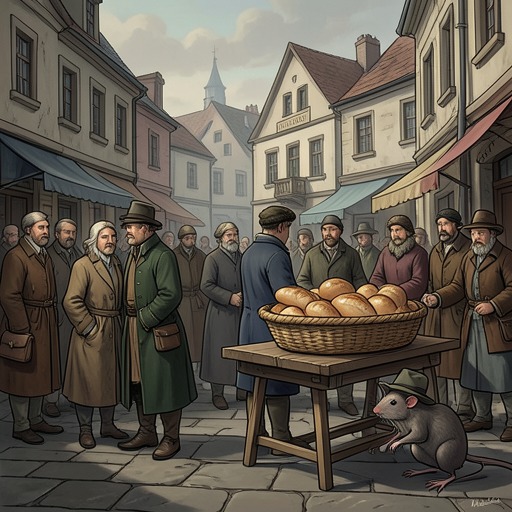
That performance is reinforced in public. Two rat-catchers arrive in their long dusty coats and battered black top hats, carrying poles hung with traps, large bags, and terriers on strings. The waiting crowd cheers as the men produce handfuls of what looks like black string. One announces that they have caught two hundred rats that day. The display appears to confirm the scale of the plague, but the apparent evidence is not secure. When one terrier lunges at Maurice, its handler jerks it away and drops several of the strings. Keith recognizes them as rat tails; Maurice sees a chance to inspect them and asks Keith to pick them up unseen. Before he can, a rat-catcher plants a shiny black boot on the tangle and warns him that touching rats could give him plague. The aggressive warning helps protect the evidence from examination even as it advertises the danger the men claim to be fighting.
False evidence and an absent population
Sardines gives the inquiry its central contradiction. Asked why there are no rats in the city, he explains that he has found rat runs, a few dead rats, old skeletons, piles of poison, and many traps—but no living rats. That absence sits uneasily beside the daily display of tails. Malicia objects that the rat-catchers nail up plenty of them, and Maurice answers that at least some are fake: they are old leather bootlaces. His certainty rests on having seen them in the street and on his familiarity with what rat tails look like.
The bootlaces turn the public proof of the infestation into a clue to its fabrication. The evidence is partial rather than absolute—Maurice identifies some tails as false, not every tail—but it is enough to make the daily claims suspect. The rat-catchers’ warning about plague also takes on a different meaning: it discourages scrutiny of the very objects that might expose the fraud. Meanwhile, the town’s fear is not wholly invented from nothing. Malicia points to gnawed bones, empty egg baskets, and rat droppings as things people have actually found. The operation’s deception works by attaching its claims to experiences that residents already interpret as signs of rats.
The hidden food and the caged rats
The investigation reaches beyond the false tails when Maurice and Malicia enter a cellar. Its contents contradict the claim that rats have taken everything: nets overhead hold large white cabbages, sausages loop from beam to beam, and the room contains jars, barrels, and sacks of food. Malicia recognizes the place as a hiding spot and realizes that the rat-catchers know the sewers and cellars well enough to reach it. Maurice is not satisfied with finding the food. He suspects that the men have been stealing provisions and then blaming the rats, while Malicia notes that the town’s reports of gnawing and droppings have helped make that story plausible.
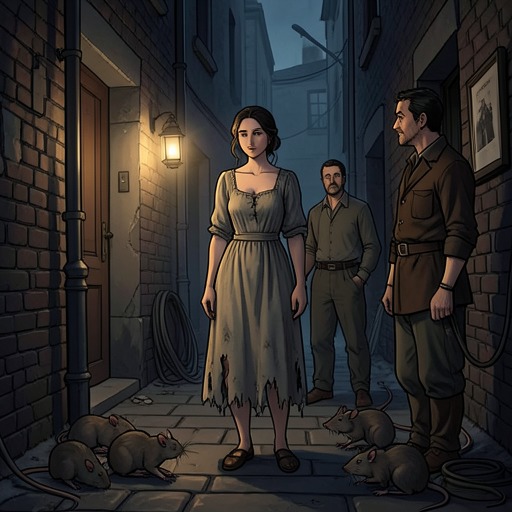
The cellar is not the only concealed part of the operation. Elsewhere, the investigation opens a room filled with rats: cages are crammed from wall to wall and floor to ceiling, and netting strains under the weight of their bodies. The air is thick with noise and stench, while the surviving members of Hamnpork’s exploration party are clustered in the middle of the room. The discovery changes the meaning of the earlier absence. Rats are missing from the streets, but not because the town is free of them; they have been gathered and confined out of sight. Their terror is so overwhelming that rats fleeing the room have forgotten how to talk, and even Maurice feels the pressure of the mass as Keith breaks down the door.
The caged animals also point to a further use for the rat-catchers’ supply. Maurice later explains that the men brought living rats to barns, released them into a wooden ring, and set terriers on them for rat-coursing. The rats mostly ran in panic rather than fighting. This account extends the operation from concealment and fraud into the use of captured animals for public entertainment, and helps explain why the rats were kept alive rather than simply killed for the advertised reward.
Confrontation and consequences
At the shed, Malicia puts the evidence directly to the rat-catchers: she accuses them of stealing food, blaming the rats, and keeping the animals caged. She also invokes the aglets—the small tips on bootlaces—connecting the cellar confrontation to the earlier discovery of fake tails. The rat-catchers answer by accusing the group of breaking into their shed, but that countercharge does not resolve the questions raised by the hidden provisions, the false evidence, and the cages. The exposure is therefore not merely a dispute over a suspicious detail; several parts of the operation converge in one place.
The revelation also shifts the stakes for the town and the rats. The rat-catchers had been able to present themselves as protectors against vermin while profiting from the fear and scarcity attributed to it. Once the food stores, bootlace tails, and imprisoned rats are seen together, that public role is exposed as a cover for exploitation. The discovery does not, by itself, establish that the town has already punished the rat-catchers or resolved its shortages. Instead, it creates the conditions for a different response: in the later confrontation with the mayor, Darktan offers negotiation rather than a threat, and Maurice describes a possible arrangement in which humans and rats can live by agreed rules. The investigation’s decisive consequence is thus a change in what the town must confront: not an imaginary problem of rats alone, but a criminal operation and the possibility of coexistence with the thinking rats it had treated as pests.